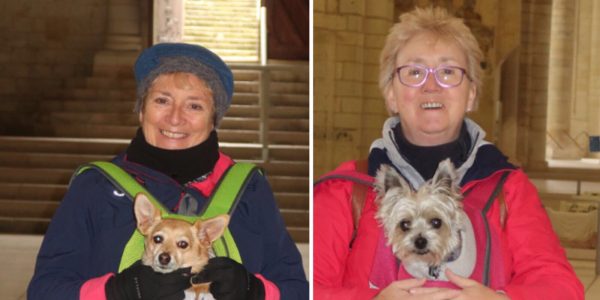
Sorry folks I thought I had published this post ages ago – a bit out of date now, but here goes…
Talk about keeping the best till last… Seville was the most wonderful city I have ever visited, it has knocked Zaragoza and Morella off my top spots! There was so much to see that we could have done with 10 days there instead of just 2. Mind you the heat was something else for early October, but nonetheless, it was fabulous and we will definitely be going back as there was so much we didn’t see!


The history of Seville
Seville is the capital and largest city of the autonomous community of Andalusia and the province of Seville and is the fourth largest city in Spain. The inhabitants of the city are known as sevillanos or sevillanas. The Seville harbour, located about 80 kilometres from the Atlantic Ocean, is the only river port in Spain. Seville is also the hottest major metropolitan area in the geographical Southwestern Europe, with summer average high temperatures of above 35 °C and these temperatures rolled out to early October when we were there!
Seville was founded as the Roman city of Hispalis and later became known as Ishbiliyya after the Muslim conquest in 712. During the Muslim rule in Spain, Seville came under the jurisdiction of the Caliphate of Córdoba before becoming the independent Taifa of Seville; later it was ruled by the Muslim Almoravids and the Almohads until finally being incorporated into the Christian Kingdom of Castile under Ferdinand III in 1248. After the discovery of the Americas, Seville became one of the economic centres of the Spanish Empire as its port monopolised the trans-oceanic trade, opening a Golden Age of arts and literature. In 1519, Ferdinand Magellan departed from Seville for the first circumnavigation of the Earth.
Cathedral of Seville
The St. Mary of the See Cathedral was built from 1401–1519 after the Reconquista on the former site of the city’s mosque. It is among the largest of all medieval and Gothic cathedrals, in terms of both area and volume. The interior is the longest nave in Spain, and is lavishly decorated, with large quantities of gold. La Giralda is a tower attached to the Cathedral that dates back to the twelfth century. It was originally built as part of a mosque when the Moors ruled in Spain and was later added onto by the Christians.


Christopher Columbus Tomb
Visitors to the cathedral flock to see the ornate tomb of Christopher Columbus, who was buried there in 1898. Yet Santo Domingo, the capital of the Dominican Republic, also claims to possess the explorer’s remains. Over 500 years since Columbus’ death, there is still mystery and intrigue surrounding his exact burial spot!
The confusion has arisen because Columbus’ remains saw almost as much travel as the explorer did during his lifetime. He died in the northern Spanish city of Valladolid in 1506, after returning from his final expedition to the “New World”, only to be moved to a monastery near Seville three years later. But in 1537, the newly opened cathedral of Santa Maria la Menor in Santo Domingo – a territory founded by Columbus – was deemed a much grander burial site, so the Genoese explorer’s remains embarked on their second journey, this time to the Dominican Republic.
What was left of the revered navigator stayed in the cathedral at Santo Domingo until 1795, when France took control of Hispaniola (the Caribbean island that is now split between the Dominican Republic and Haiti) from Spain under the terms of a peace treaty. Not wanting the French to take possession of Columbus’ remains as well, the Spanish had them removed to Cuba, then part of Spain’s extensive global empire. Yet by the end of the 19th century the Spanish Empire was a fading force and in 1898 the Spaniards renounced control of Cuba – as well as handing over Puerto Rico and The Philippines to the United States – in the Treaty of Paris. Columbus was moved back to Seville and buried in a forbidding tomb inside the city’s cathedral, thus completing his fourth posthumous journey.
However, the Dominican Republic claims, not without foundation, that Columbus’ remains never made that final trip back to Spain. In 1877, workers in the Santo Domingo cathedral from which the explorer had supposedly been removed over 80 years earlier discovered a container of remains labelled “The illustrious and excellent man, Don Columbus, Admiral of the Ocean Sea”. Ever since, the Dominicans have claimed that Spain transported the wrong remains out of Santo Domingo in 1795 – a fact which, if true, means that someone else entirely lies in the imposing tomb in Seville’s cathedral.
There you are now!


Alcázar
The Alcázar was developed from a previous Moorish Palace which in turn was developed from a Visigoth establishment which was itself developed from an existing Roman construction. Redevelopment was started in 1181 and continued for over 500 years, mainly in the Mudéjar style, but also in the Renaissance style. The popular TV show Game of Thrones has shot many scenes at this location.
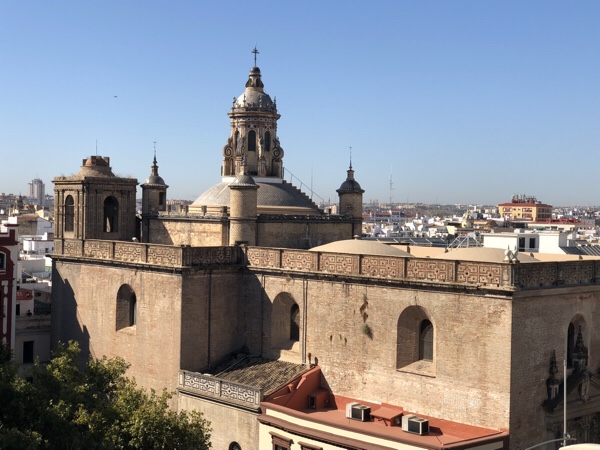

Golden Tower
The “Torre del Oro” was built as a watchtower and defensive barrier on the river. A chain was strung through the water from the base of the tower to prevent boats from traveling into the river port.

Plaza de España
The Plaza de España, in Maria Luisa Park, was built by the architect Aníbal González for the 1929 Exposición Ibero-Americana. It is an outstanding example of Regionalist Revival Architecture, a bizarre and loftily conceived mixture of diverse historic styles, such as Art Deco and lavishly ornamented with typical glazed tiles. There are several Moorish elements, some are very beautiful remains of former important Sevillan mosques.


Metropol Parasol
The Metropol Parasol is a wooden structure located at La Encarnación square, in the old quarter of Seville. It was designed by the German architect Jürgen Mayer and completed in April 2011. It claims to be the largest wooden structure in the world. Its appearance, location, delays and cost overruns in construction resulted in much public controversy. The building is popularly known as Las Setas de la Encarnación (Incarnation’s mushrooms). It did look quite spectacular when you approached it and is quite a structure to tour around, but in my opinion was a little out of place in the centre of the old town.


Bullring
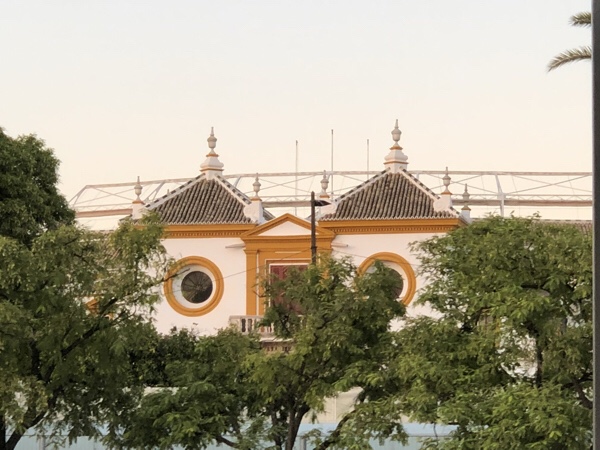
The Plaza de toros de la Real Maestranza de Caballería de Sevilla is a 12,000-capacity bullring. During the annual Seville Fair in Seville, it is the site of one of the most well-known bullfighting festivals in the world.
Boat trip on the river Guadalquivir
The Guadalquivir is the second longest river in Spain and is the only great navigable river in Spain. Currently it is navigable from the Gulf of Cádiz to Seville, but in Roman times it was navigable to Córdoba. We took a lovely one hour cruise on the river where we could see all the monuments and then further up past the Expo 92 Exhibition Centre where all the more modern bridges and buildings are, it was lovely and it was nice and cool. The Spanish make the most of the water for all their water sports.


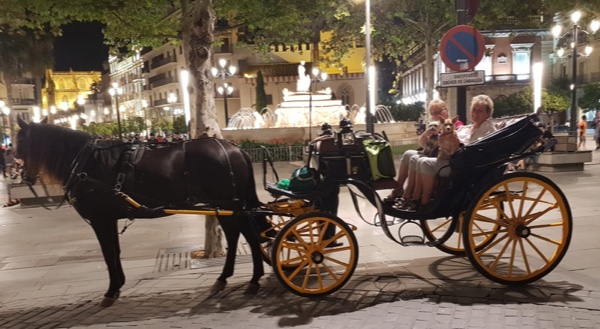
After the boat trip we took a horse drawn carriage around all the major tourist attractions and at night it was fantastic, the dogs enjoyed it as much as the boat trip up the river. It was beautiful to see all the monuments lighted up despite having to travel through all the traffic – mind you the dogs proved quite a tourist attraction!!


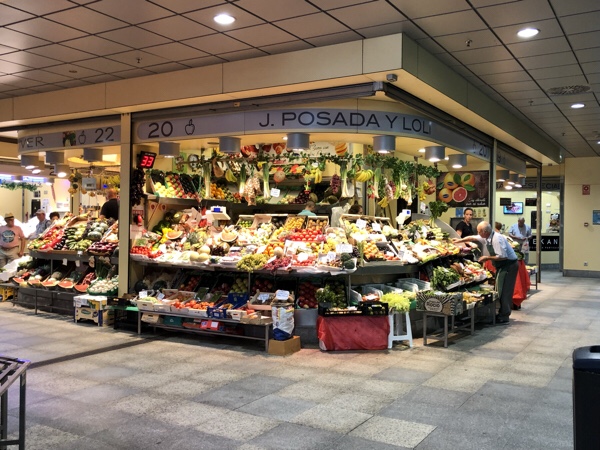
And where would you get a fruit shop like this…
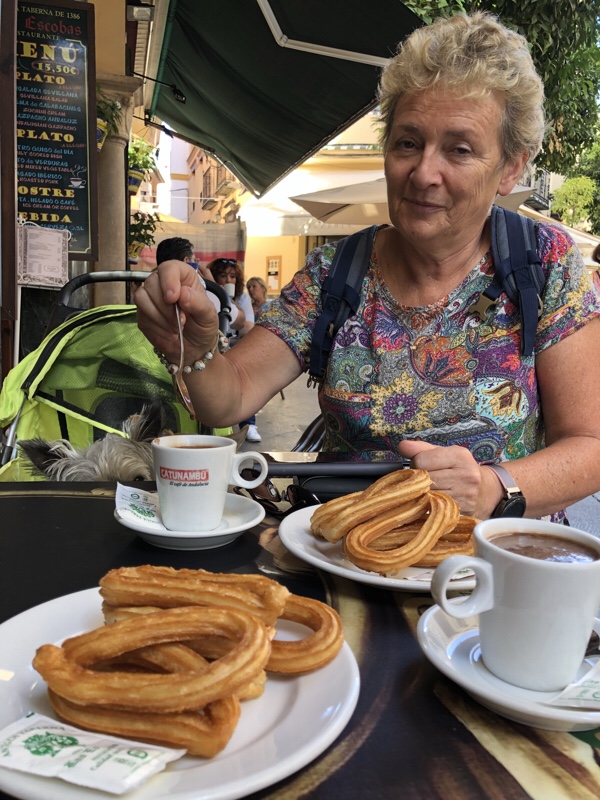
And as for the churros…..
 Mutts on Tour
Sounds amazing.
LikeLiked by 1 person
It is.
LikeLike
How beautiful!
LikeLiked by 1 person