Córdoba was a Roman settlement, then colonized by Muslim armies in the eighth century. It became the capital of the Islamic Emirate, and then of the Caliphate of Córdoba, including most of the Iberian Peninsula. During this period, it became a centre of education and learning, and by the 10th century had grown to possibly the largest city in Europe. It was recaptured by Christian forces in 1236, during the Reconquista. Today, Córdoba is still home to many notable pieces of Moorish architecture such as the Mezquita, which was named as a UNESCO World Heritage Site in 1984, and is currently in use as a Cathedral. The UNESCO status has since been expanded to encompass the whole historic centre of Córdoba. Much of this architecture, such as the Alcázar and the Roman Bridge has been reworked or reconstructed by the city’s successive inhabitants.
During the process known as the Spanish Reconquista, Córdoba was captured by King Ferdinand III of Castile on 29 June 1236, after a siege of several months. The city was divided into 14 collations, and numerous new church buildings were added. The centre of the mosque was converted into a large Catholic cathedral.
The Mezquita of Cordoba is one of the world’s most impressive buildings making it one of the most remarkable tourist attractions both in Cordoba and Spain. It is not only the largest mosque in the entire world, but the largest temple in the world, as well. When you enter this magnificent temple it is breath-taking and we had never seen anything like it. Both Sheila and I visited it at 8.30am when it opened for individual tourists (no groups) and so there weren’t too many people there and so you could truly appreciate the architecture and structure without 100s of selfie sticks getting in the way!
The city declined, especially after Renaissance times. In the 18th century it was reduced to just 20,000 inhabitants. The population and economy started to increase again only in the early 20th century.
The Mezquita
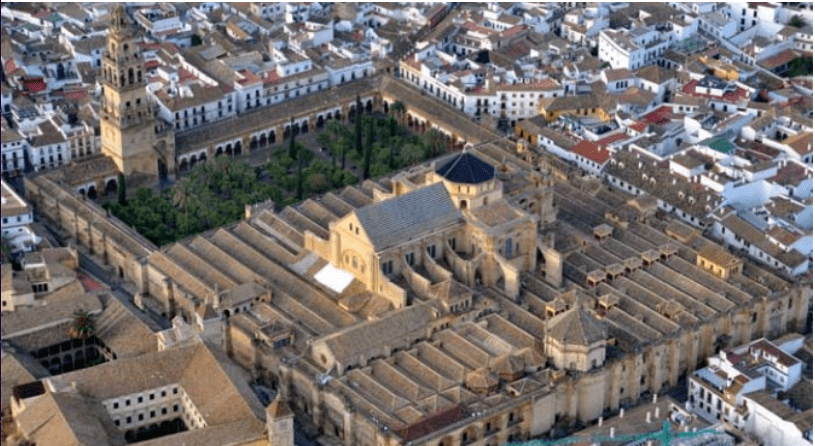
The Mosque–Cathedral of Córdoba, also known as the Great Mosque of Córdoba, whose ecclesiastical name is the Cathedral of Our Lady of the Assumption is the Catholic cathedral of the Diocese of Córdoba dedicated to the Assumption of the Virgin Mary and located in the Spanish region of Andalusia. The structure is regarded as one of the most accomplished monuments of Moorish architecture.
According to a traditional account, a small Visigoth church, the Catholic Basilica of Saint Vincent of Lérins, originally stood on the site. In 784 Abd al-Rahman I ordered construction of the Great Mosque, which was considerably expanded by later Muslim rulers. Córdoba returned to Christian rule in 1236 during the Reconquista, and the building was converted to a Roman Catholic Church, culminating in the insertion of a Renaissance cathedral nave in the 16th century.
The building is most notable for its arcaded hypostyle hall, with 856 columns of jasper, onyx, marble, granite and porphyry. These were made from pieces of the Roman temple that had occupied the site previously, as well as other Roman buildings, such as the Mérida amphitheatre. The double arches were an innovation, permitting higher ceilings than would otherwise be possible with relatively low columns. The double arches consist of a lower horseshoe arch and an upper semi-circular arch. The famous alternating red and white voussoirs of the arches were inspired by those in the Dome of the Rock and also resemble those of the Aachen Cathedral, which were built almost at the same time. Horseshoe arches were known in the Iberian Peninsula since late Antiquity, as can be seen on the 3rd-century “Estela de los Flavios”, now in the archaeological museum of León.
The edifice also has a richly gilded prayer niche or mihrab. The mihrab is a masterpiece of architectural art, with geometric and flowing designs of plants. Other prominent features were an open court (sahn) surrounded by arcades, screens of wood, minarets, colourful mosaics, and windows of coloured glass. The walls of the mosque had Quranic inscriptions written on them. As many adherents of Islam reject sculptural or pictorial representations of people or of God within religious contexts, all decoration of the cathedral is accomplished through tile work, calligraphy and architectural forms. Arrazi, an Arab writer, speaks of the valuable wine-coloured marble, obtained from the mountains of the district, which was much used in embellishing the naves of the mosque.
Since the early 2000s, Spanish Muslims have lobbied the Roman Catholic Church to allow them to pray in the cathedral. This Muslim campaign has been rejected on multiple occasions, both by the church authorities in Spain and by the Vatican.


I hope these photos give you a feel for the absolute magnificence of the Mezquita.
The Alcazar
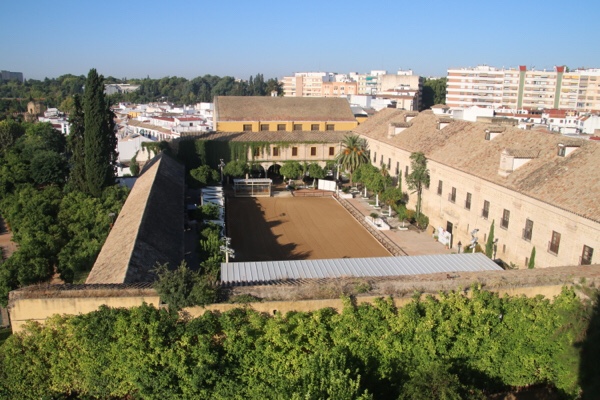
The Alcazar has always been an important place in Cordoba. It used to be the residence of Roman governors and Moorish caliphs, and in 1328 it became the home of the Spanish kings when they were in Cordoba.
It is known as the Alcazar of the Reyes Cristianos because the Christian Kings Fernando and Isabella lived in the castle for over eight years while they orchestrated the reconquest of Granada. It was in the Alcazar that Christopher Columbus pitched his idea of looking for a Western route to reach India.
After the reconquest of Spain was complete, Fernando and Isabella donated the building to the church of Cordoba, who made it the site of the Courts of the Holy Offices (the feared Inquisition). In the centuries after that, the castle was used as a civil prison, and later as a military one. Nowadays the building is a Historical Monument and a UNESCO World Heritage Site. It doubles as a museum and a place for public and private events (concerts, weddings, etc.).
It was strategically built on the banks of Guadalquivir River, to the south-west of the old town. Outside it has stunning patios and gardens. The big interior patio boasts some remains of the old structure that was constructed when the Moorish caliphs reigned Cordoba. The large garden was added by the Christian Kings Fernando and Isabella, but its style was influenced by Moorish gardens and patios. When I arrived at the Alcazar I was welcomed by the beautiful sound of Andrea Bocelli singing “Time to say goodbye” and the fountains were ‘dancing’ in time to the music – it was magical and I was so lucky to see it.


The Peurta del Puente
The Puerta del Puente is one of the only three remaining doors in the city of Córdoba, next to the Puerta de Almodóvar and the Puerta de Sevilla. The current gate is located in an enclave where once Roman and Muslim doors were also located. In Roman times it linked the city with the Roman Bridge and the Via Augusta. The Roman Bridge (Puente Romano) a 330 metre long bridge made entirely of stone and sitting on 16 arches embedded into the river bed. The bridge is now pedestrianised, but until recently it had been one of the main traffic bridges in Cordoba for nearly 2,000 years. At the far side of the bridge is the Calahorra Tower and museum.


Exploring this beautiful city, just wandering through the streets you would never know what you would come across there were just so many incredible buildings and monuments and we saw quite a few of them in a relatively short time and in unbelievable heat!


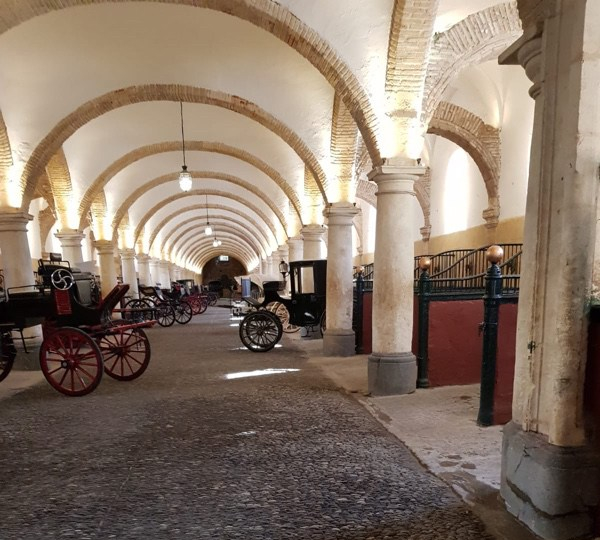


Cordoba is defo on the revisit list!
 Mutts on Tour
Fantastic Ger. Cordoba is definitely on the visit list. Hope you are enjoying all the lovely places. You should write a book about each. Actually you have!
Looking forward to hearing all your news when you are both back in Dublin. Golf or no golf.
Jim
LikeLike
Thanks Jim. It was the most amazing trip. I haven’t done the last city yet and it was certainly a case of keeping the best till last 😘. Looking forward to to seeing when we are back. 😎
LikeLike