Having toured the Palais des Papes for a couple of hours before leaving Avignon and climbing 100s of steps up to the Palais and then within the Palais climbing right up to the turrets we were well rested after the drive down into Spain and ready to do it all again in Girona…… and then some 😳
Girona is an amazing city and thankfully it had stopped raining by the time we arrived and we had a couple of hours to explore before we ran out of energy 🤓
To give you some history on Girona…..
The first historical inhabitants in the region were Iberians; Girona is the ancient Gerunda, a city of the Ausetani. Later, the Romans built a citadel there, which was given the name of Gerunda. The Visigoths ruled in Girona until it was conquered by the Moors in 715. Finally, Charlemagne reconquered it in 785 and made it one of the fourteen original counties of Catalonia. It was wrested temporarily from the Moors, who recaptured it in 793. From this time until the Moors were finally driven out, 1015, the city repeatedly changed hands and was sacked several times by the Moors (in 827, 842, 845, 935, 982). Wilfred the Hairy incorporated Girona into the County of Barcelona in 878. Alfonso I of Aragón declared Girona a city in the 11th century. The ancient county later became a duchy (1351) when King Pero III of Aragon gave the title of Duke to his first-born son, John. In 1414, King Ferrando I in turn gave the title of prince of Girona to his first-born son, Alfonso. The title is currently carried by Princess Leonor of Asturias, the second since the 16th century to do so.
Girona has undergone twenty-five sieges and been captured seven times. It was besieged by the French royal armies under Charles de Monchy d’Hocquincourt in 1653, under Bernardin Gigault de Bellefonds in 1684, and twice in 1694 under Anne Jules de Noailles. In May 1809, it was besieged by 35,000 French Napoleonic troops under Vergier, Augereau and St. Cyr, and held out obstinately under the leadership of Alvarez until disease and famine compelled it to capitulate on the 12th of December. Finally, the French conquered the city in 1809, after 7 months of siege. Girona was center of the Ter department during the French rule, which lasted from 1809 to 1813. The defensive city walls were demolished at the end of the 19th century to allow for the expansion of the city.
The ancient cathedral, which stood on the site of the present one, was used by the Moors as a mosque, and after their final expulsion was either entirely remodelled or rebuilt. The present edifice is one of the most important monuments of the school of the Majorcan architect Jaume Fabre and an excellent example of Catalan Gothic architecture. It is approached by eighty-six steps. An aisle and chapels surround the choir, which opens by three arches into the nave, of which the pointed stone vault is the widest in Christendom (22 meters). Among its interior decorations is a retable which is the work of the Valencian silversmith Pere Bernec. It is divided into three tiers of statuettes and reliefs, framed in canopied niches of cast and hammered silver. A gold and silver altar-frontal was carried off by the French in 1809. The cathedral contains the tombs of Ramon Berenger and his wife.


86 steps up 🙈
The old fortifications were incredible. Historically, these have played a vital role in protecting Girona from invaders for hundreds of years. The city wall of the old town was an important military construction built in Roman times in the 1st century BC. It was thoroughly rebuilt under the reign of Peter III the Ceremonious in the second half of the 14th century. The Roman wall was used as a foundation. At the start of the 16th century, the wall was absorbed in the city. The walled precinct lost its military value. Bit by bit, the wall was degrading, as parts were gradually altered from the inside and the outside. The walls and lookout towers that make up these fortifications are split in two – a small section in the north of the old town and a much larger section in the south. It is possible to walk the entire length of the walls and climb the towers, where visitors can enjoy panoramic views of Girona and the surrounding countryside. And we did!


The “Casas de l’Onyar” are characteristic of Girona, these are the picturesque houses overlooking the river Onyar. These were built over many years and give the flavour of a small Mediterranean city. The façades are painted according to a palette created by Enric Ansesa, James J. Faixó and the architects Fuses and J. Viader. I’d recognise that jacket anywhere!
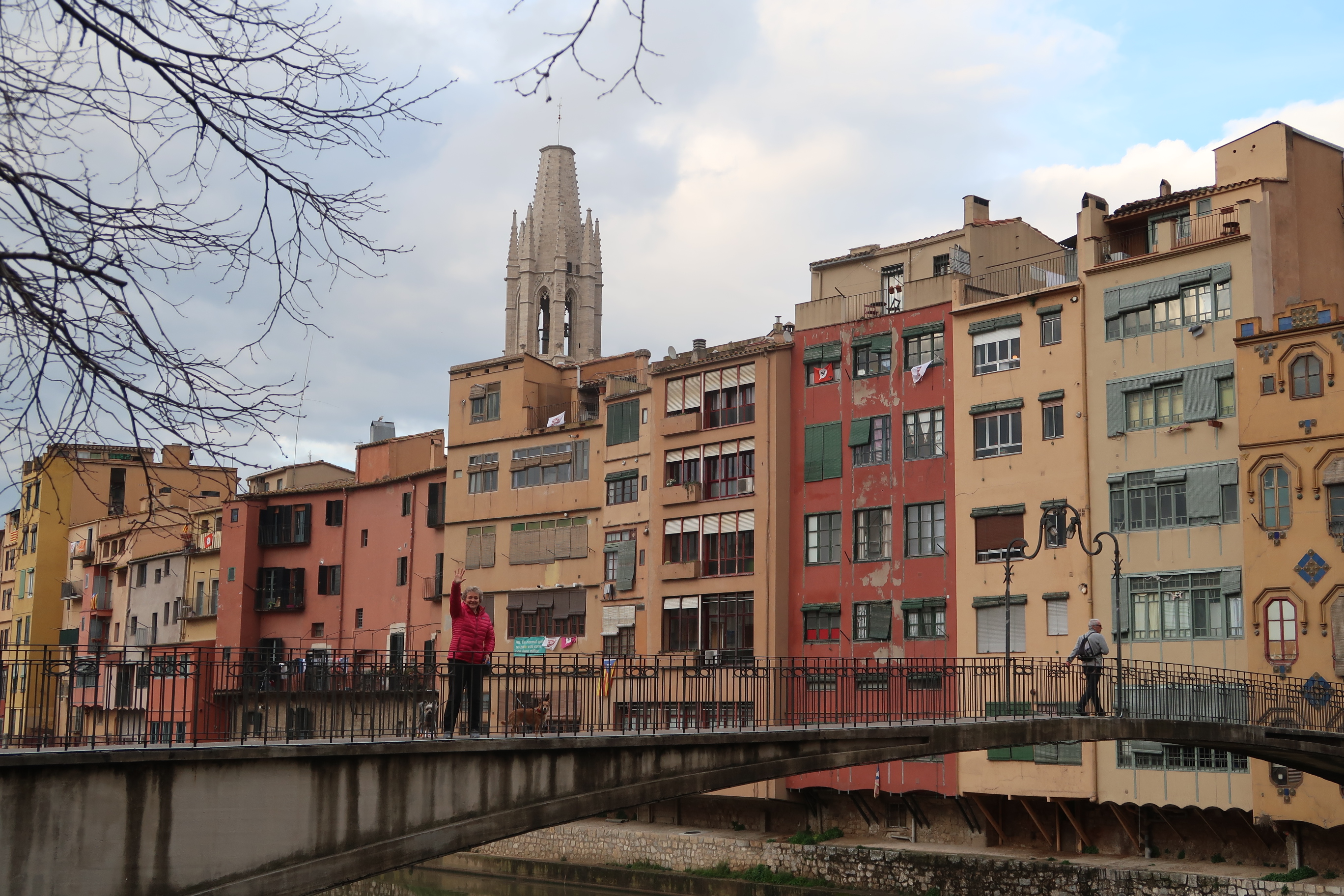
Bring the buggy she says 😳
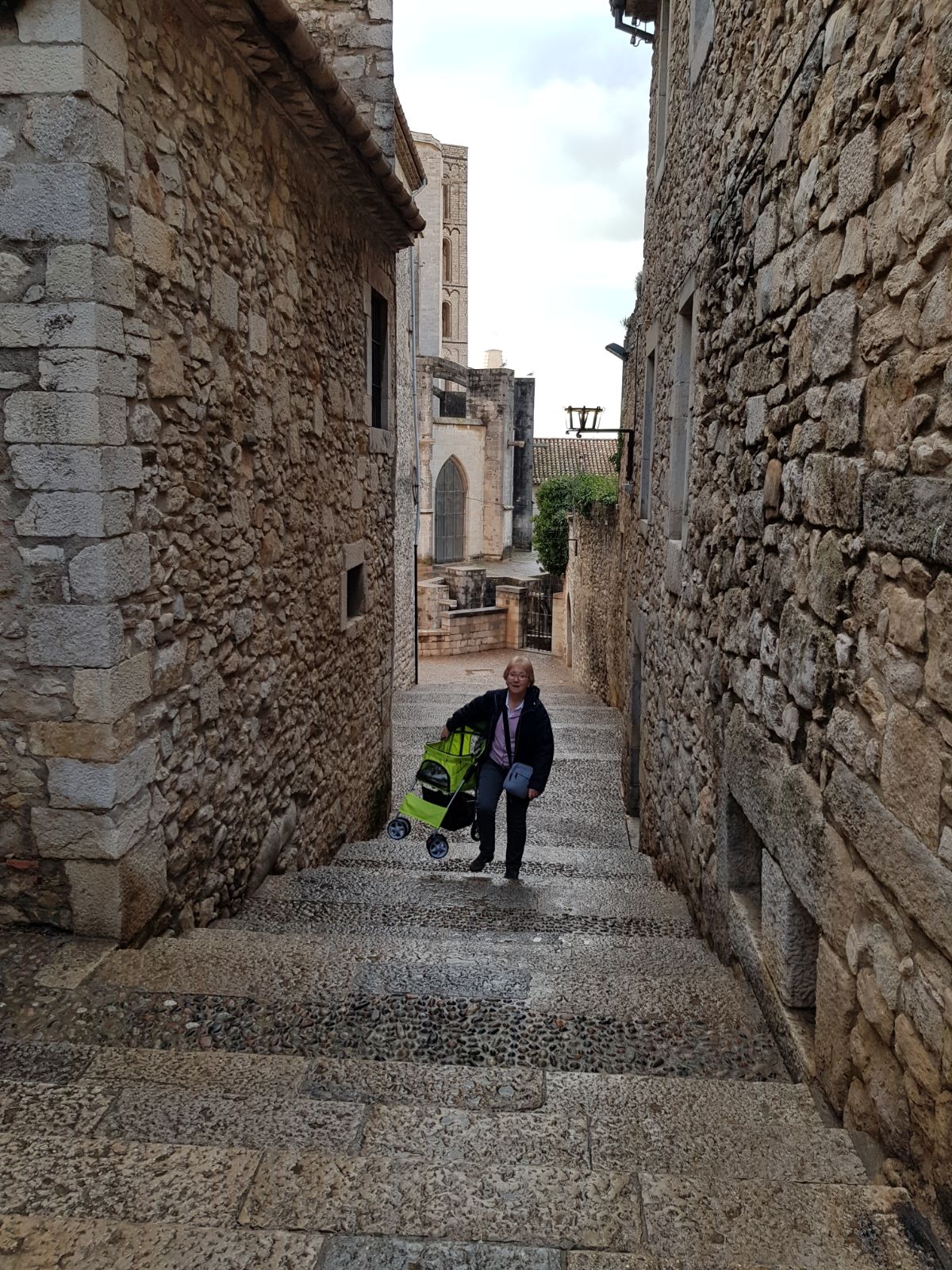
Well there was no way I was carrying it down those steps….
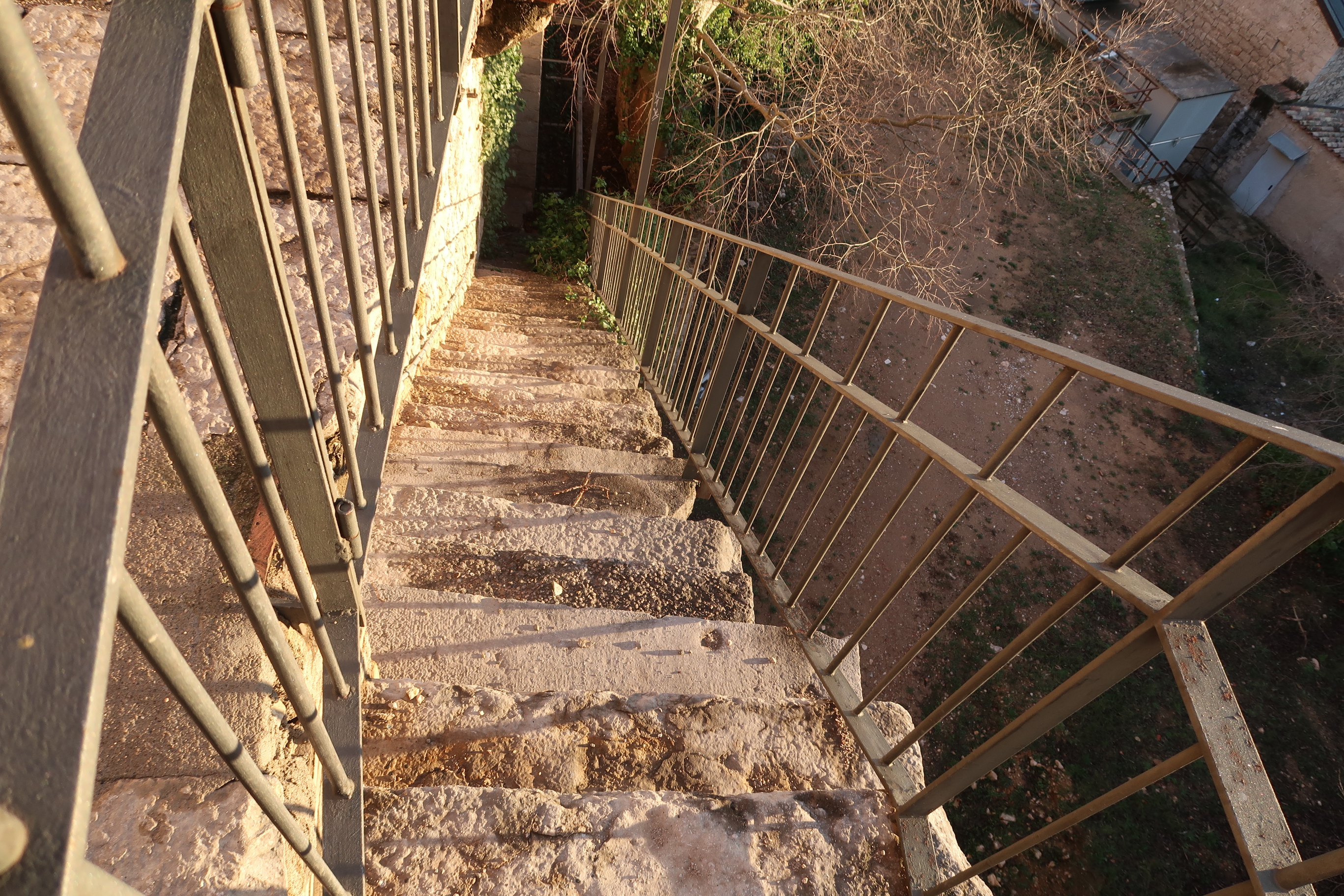
It is no wonder that tonight Sheila’s knees are totally jiggered – her Physio told her to avoid stairs.🙊 I’ll never get her moving in the morning. Also everywhere we go all the streets are cobbled and you’ve no idea how hard it is pushing dog’s buggy on cobbled stones 😝 🐕 🐶

 Mutts on Tour