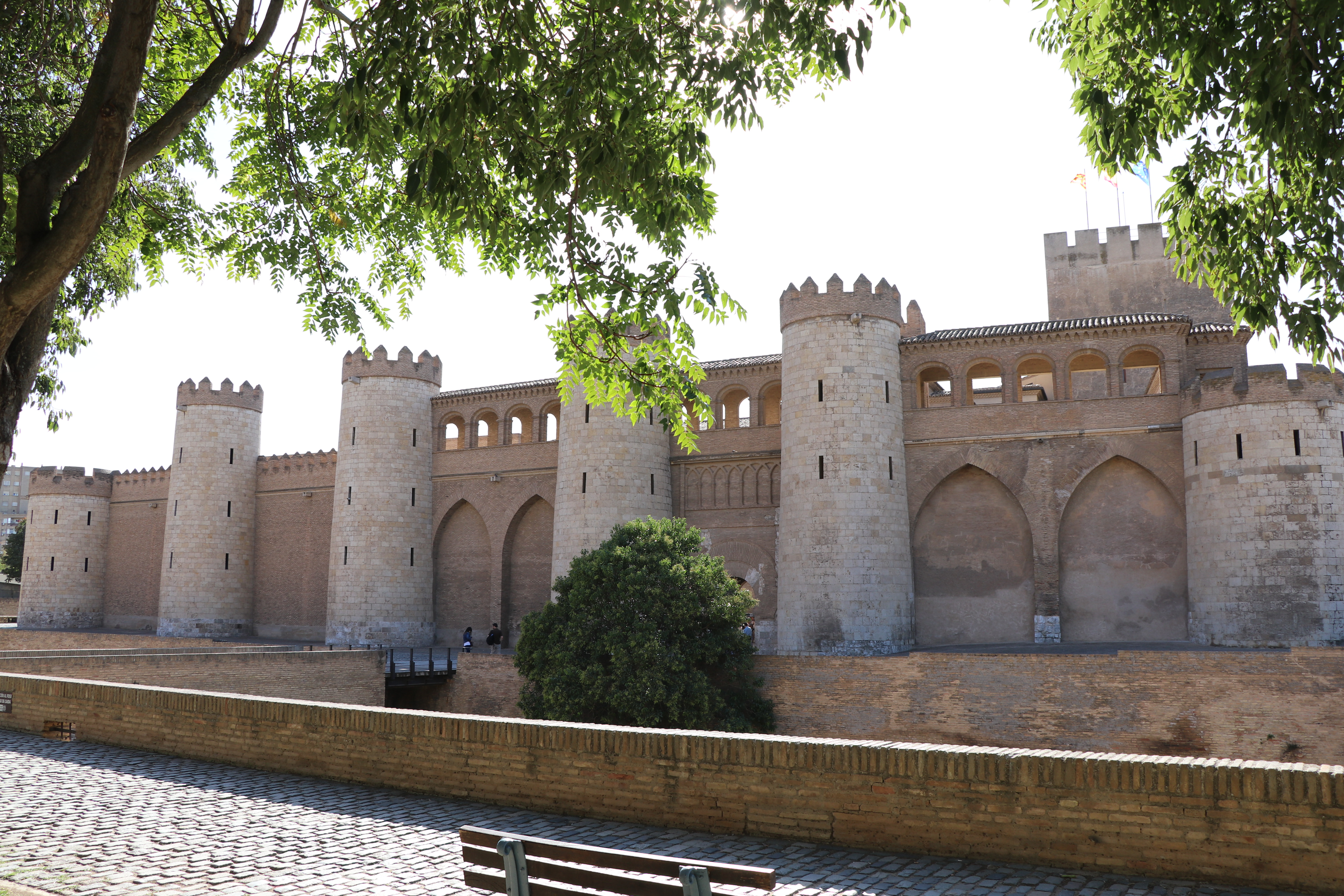
The palace, the current headquarters of the Cortes de Aragón, is a building of singular beauty. Its long existence throughout history allows us to observe the delicate ornamental beauty of a taifal palace of the eleventh century, the extraordinary wooden carvings in the form of alfarjes of the Mudejar artists who worked in the medieval Christian palace and the magnificence of the time of the Catholic Monarchs, with its throne room, in which it astonishes the spectacular roof of golden and polychrome wood.
The Aljafería has lived several avatars, changes and stages. Once the restoration work of the monument has been completed, it is now a living and open building, a cultural landmark in our city.
ISLAMIC PALACE:
Its compositional scheme, based on an open rectangular patio with a swimming pool on the south side, develops two porticoes with mixtilinear arches and polilobulate as visual screens and in the background, tripartite rooms destined for ceremonial and private use. In the north portico there is a small oratory of octagonal plant and decoration of plaster (atauriques).
PALACE MUDÉJAR:
In the 12th century the palace began its Christian journey, becoming the palace of the Aragonese monarchs. From this period stand a series of rooms corresponding to rooms of the palace of the king Pedro IV decorated with splendid ceramics, which are of vital importance for being a focus of irradiation for the formation of Mudejar Aragonese art.


 Mutts on Tour